Thank you just for landing on this page. I’m Deacon Rodda, founder and sqgler-in-chief here at SQGLZ. I’ve produced this tidy little essay detailing how and why I’m doubling down on my business’s dedication to social and ecological changemaking. And, I’m going to be up front. At the end of the essay, I’m going to ask for your help.
Design is
Problem Solving
I don’t think I’ve ever written this much about SQGLZ. But, it was time. I needed to pull together the history and thinking that led me to tighten focus. I believe that it will give context to the audacious quest that I’m kicking off, a quest to spread the good news of social permaculture design and all of the problems that it can solve. At the bare minimum, a few people are going to be able to relate better to the social groups they’re a part of. Potentially, though, social permaculture design could avert a second American civil war and restore global topsoil. Note: Earth’s topsoil is predicted to be depleted within about sixty years, which is a potential human extinction event separate from, but not unrelated to, climate change.
I know that there are a few of you who are really into reading long form pieces and some who read the headlines and get back to making beautiful things happen in the world. In the interest of helping you help me help you, I’ve composed both a short and a long version.
Take your pick. And, thank you again.
short version
short version:
A long time ago, I spent most of my time studying fine art (painting, creative writing, and classical punching and kicking). Then, by windfall, I found myself screen printing band shirts. Screen printing opened up opportunities for other print and design gigs, which opened up opportunities in user interface design, which led to software development and marketing work. Somewhere along the line, I fell in love with solving for the underlying organizational problems.
Now, solving problems is all I want to do.
Business problems aren’t enough. Even non-profit problems aren’t enough. I want SQGLZ to solve the problems of society on the whole. Through work with the Denver Permaculture Guild’s social permaculture design course facilitators team (the Metapod), The GrowHaus, The Co-op at 1st Ave., and establishing such projects as COjacks and the Favor Solutions Network, I’ve gotten a real taste for how productive a fusion of inquiry-led design processes and grassroots organizing can be. We can regenerate our communities. We can become self-directed individuals, families, and organizations. We can heal our relationships to each other and the earth itself.
SQGLZ is making a shift, to focus on studying, developing, prototyping, facilitating, and teaching the social permaculture design system and related processes. This work will leverage existing client relationships with companies like Forever Redwood and Bruce Lipton’s Mountain of Love Productions. These companies work tirelessly to restore old growth forests and to restore human regenerative capacity. SQGLZ will deepen its relationships with firms like the Denver Permaculture Guild and Regenerate Change. SQGLZ will spread practical skills for regenerative design practices as broadly as it is capable. I cannot imagine a more critical call to answer than to help human societies everywhere to slow, mitigate, and —when possible — reverse the coming climate and cultural crises which we know we must face.
To this end, SQGLZ has already:
- established a non-extractive complementary currency, the Favor
- furthered the development of the social permaculture design curriculum
- generated new educational materials for fostering regenerative change
I would be honored if you’d join me on this journey — in any way. The most direct way you can help is to support the work of SQGLZ on Patreon. For two dollars a month you can help make it possible for me — Deacon — to continue organizing the Favor, to produce learning materials for the Social Permaculture Design Course, and to research and develop new design solutions for social and ecological problems. What’s more, there are a lot of brilliant designers and thinkers that SQGLZ brings in on client projects. But, I haven’t been able to bring in those same contractors for in-house projects. With community support, SQGLZ could grow its team and implement even more world-changing solutions.
Not ready, to commit to support SQGLZ on Patreon? No worries.
Want more details? Hey, you clicked ‘short version’. But, in all seriousness, are you subscribed to the SQGLZ newsletter? Following me on Instagram? Want to get involved directly? Get on my calendar here. Want to get on the waitlist for the social permaculture design course? Here’s that. I don’t know … I think that’s all I got. Feel free to email or text if you have any other questions.
long version:
Once upon a time, a friend was moving across the country and dropped a screen-printing rig on my lap. They said something to the effect of, “You went to art school, you’ll get some use out of this.” Anyone who’s known me long enough has heard that tidy little anecdote about the origins of SQGLZ. There are a lot of details that don’t fit into the normal telling of that story. Like, the ceiling in the basement where I started my commercial printmaking career was about six feet high. I built a modular table with really short legs and did most of my printing in a low horse stance that would have made Shaolin monks, very subtly, nod in approval. The only clients I could keep were punk bands and Pablo’s Coffee — because Craig (owner of Pablo’s and victim/hero/sage of too many of my business anecdotes) was perineally patient with my awful screen printing technique.
Screen printing band shirts opened doors into flyers and poster production, led to all sorts of graphic design gigs, led to digital media exploration, led to user interface design, led to dabbling in programming and web development. In short order, I had a wealth of varyingly shallow mini-careers making a whole lot of merry and very little progress. You see, the profits of nearly everything I’ve done have been invested in learning the next thing. Student debt has nothing on the cost of running a meandering, unfocused design business. Still, I don’t know that I’d trade the experience of the last fifteen years for several times the money I’ve lost. You see, I believe — with deep sincerity and some relevant evidence to support me — that all of that education and experience were an important beginning.
I believe that this little design firm will meaningfully change the world.
A Passion Foretold
One of those clients I lost, during those early times in the basement, was Primo jelly. They were just starting out too, back in 2006. I printed a run of shirts for them. It was a very simple design. Just a black T-shirt that had the Primo logotype in the center. My screen had pinholes in it. No one had ever brought them up before. I thought they were a desirable part of the screen printed look. I showed the shirts to Vic, chef, founder, owner, and —then — sole employee of Primo. He saw things differently. He sat down with me and just asked me, “Did you see these little white spots while you were printing the shirts?” The conversation sauntered down a predictable path. “Yeah, I’m not looking for the same things that the bands you’re working with are looking for.” That was the paradigm shifting moment for me. Businesses have legitimately different needs — even aesthetically.
I studied fine arts. This stuff was new to me.
After that, though, I really did start getting more creative fulfillment from problem solving and understanding organizations as unique entities, complete with unique personalities and needs. Non-profit managers, business owners, and band front-people would come into my office (eventually I had an office). They would tell me what they were looking for and I would ask questions. Sometimes, it was my favorite part of the job.
Then, it got better!
Solving for businesses needs was nice and all, but one bright, sunny day in 2016, in a routine client meeting, I experienced a whole new level. A simple commercial/residential window washing company had been referred to us for web development by one of the brokers in a multilateral barter network of which SQGLZ is a part. My business partner, David, and I met the client at Amethyst Coffee — which I highly recommend for business meetings. We opened the meeting with the simple question, “Why do you want a new website?” We had reviewed their current site. It worked. It had their information clearly displayed. It looked like the ‘90s, but that just showed off how long they’d been at it. And, it wasn’t terrible on mobile. For a window washing company, what more could you ask for.
“I’m going to be honest with you…” our client, we’ll call him George, sounded most sincere, “John Smith has been a rival of mine for years. And, he just got a fancy new website. I just can’t stand it.”
We all laughed, but not too long. George wasn’t kidding. We looked up John Smith’s website. Sure enough, it looked pretty good. Though, I had seen it before — the layout at least. It was one of the top-selling Squarespace templates. My partner and I asked George, “What about John’s website do you like?” George talked about how modern it looked, how many pictures it had (all stock photos), how it just seemed to have higher production value. Apt observations, all. It was a more pleasing site to look at, but nothing special. It was actually the definition of off-the-shelf.
“What about this,” David asked, “John gives a flat price for all residential jobs. He’ll do any house for $100. Your site says to call for a quote. Is that something you’d like to change?”
“Absolutely not! John says that so that he doesn’t have to drive around quoting jobs. It saves some time but you can get pretty burned that way. I’m pretty sure he doesn’t always stick to it anyway.”
This was where I saw our golden opportunity. Several years prior I had actually printed the window washers union handbook, detailing their trade standards within the greater Teamsters Union, and laying down the industry standards for pricing jobs. It was a simple rubric, something a computer could apply.
“You a union member, George?”
“I am.”
David looked at me like, ‘Where is this going?’
“Well George, we can program your pricing structure directly into your site. There’ll be a form that asks a few questions, then it’ll send your prospect a quote, and you’ll get a text message with your prospect’s name, phone number, et cetera whenever someone requests a quote.”
Boom.
About two hours of programming later, we had eliminated 40% of George’s total workload. The content management system for his site allowed him to control his pricing structure by adjusting a few simple numbers. He would never have to mess with the math or the programming. He hadn’t come into that meeting looking for anything like that. He wanted a new website that looked at least as nice as his rival’s. We made his business almost twice as profitable per hour of work, and shortened the amount of time his customers had to wait by about the same proportion. It was a private victory for SQGLZ, but seeing an example that clear and specific of how much of a difference our skills and experience could make in someone else’s life, well, it changed everything for me.
All of a sudden, it wasn’t enough to hear the interests of a business owner or a non-profit director and execute their wishes. SQGLZ had made the most critical step into the role of what I believe every design firm should be. We were no longer filling orders for customers; we had begun to diagnose problems for patients. Formerly, I had been content to slap a pretty skin on whatever ambled its way into the shop. Now, I was searching — everywhere and all the time — for worthy problems to which we might apply a novel solution.
Keeping Things Light
So, I love solving problems. But there’s something else too. I also love whimsical design. For me, that whimsy is found in two things: allowing space to solve little problems with the same fervor and diligence as big problems, and in adding character and personal expression to a design solution. There’s a famous toothpick design from Japan. It looks like someone meticulously cut a little ornamentation into it on a lathe. But the design has purpose. The back is meant to snap off. The middle portion of the back has a dip, such that the tip of the toothpick can rest on it without rolling. In this way, you can set the toothpick down without it resting directly on a table. Simple, beautiful, utilitarian design. It also has character. Especially once the toothpick has been carefully positioned atop its rest, there is a character aesthetic which is clearly expressed.
This is what SQGLZ sets out to accomplish in its projects Verbing Nouns Since When, Drop Kick Can, Typerfectly, and its minim opus Cardigan IO. Each web application solves a simple problem in an elegant, but also somewhat goofy way. And, I’m proud of that.
So, can light-hearted design solutions actually bear healing fruit in the social design space. They already do. Heart moving and brilliantly simple home-grown practices like the Theater of the Oppressed and Authentic Relating are joining the ranks of more formal and complex social healing practices like Non-violent Communication and talk therapy to great success. And, the seriously silly trail has been blazed by the likes of such genius goofballs as Bill Nye and Vermin Supreme.
But, Deacon, so many of your projects have failed.
Okay, so maybe no one other than the shadow me in the back of my mind has ever said that. But, I like to listen to that guy — even though he kinda sucks. The sad truth is, that inner critic usually has a point. And, we only take away that power when we confront the reality of that point head on.
I bought a print shop in 2009, and walked away from it in 2012. I launched a local currency with over a hundred businesses backing it, and none of them use it anymore. I started a non-profit that’s actually doing really well, but only because I realized at a critical moment that I should pass the reins to someone better prepared to run it.
What begins with zeal and enthusiasm doesn’t always end up looking like we pictured it. And, I don’t think I’m alone in that experience. I don’t believe that it makes sense to give up on the kinds of change that I mean to make in the world. I’ve taken stock of the biases and habits that I have employed in sabotaging some of my best plans. And, I hope to make good on that experience by leveraging so many lessons learned.
And, you know what else, this process of social design research and education includes talking about all of those past struggles in detail. What went wrong, how, and what might be done differently.
And then there was a wild card.
It would only create confusion later on for me to not mention that my whole philosophy is massively influenced by the classical martial arts — particularly the Kurai Kotori Ryu, also Hermetic theology and the whole Western Mystery Tradition from Moses to Bardon, and the canon of Taoist political science, and also a handful of vedas that have changed my life. Using the guidance of these timeless gems, I have been teaching martial arts students of all ages for the last decade. As I’ve come to this point of laser focus on solving big problems, the world of esoterics and martial arts feels increasingly less and less separate from the world of design.
So, what do we win if this all works out?
Everyone needs a big, hairy, audacious goal, a BHAG, as it were. As Jim Rohn says, “… just for what it’ll make of you to achieve it.” I go one further. I believe that I’ve improved as a person even through dedicating myself to missions that I’ve completely air-balled. And, I’ve seen the same to be true of many others.
So, what is SQGLZ’s BHAG? I may be out of my mind, but I’ve got three — in sequence. I want people to use the Favor, as a complementary currency, as a peer to the dollar, to meet the needs in their lives. I’ll consider that project successful when there are over a few hundred people using the currency on a weekly or daily basis. That’s more people than can all know each other — which is what currency is for. We don’t need money to benefit from the skills and resources of friends and family.
Once the Favor is working at scale (because it is basically functional now, but not at any kind of scale), then I want to solve shelter-lessness in Denver. Yeah, for real, the actual end of homelessness. I believe that it can be done. I hope to live to see and have a significant hand in the actual and humane housing of the un-housed in my city. If someone beats me to it, that would be fantastic. I would just move on to audacious goal number three.
SQGLZ, having helped to establish viable holistic money and having seen the end of homelessness in Denver, would like to provide a viable holistic solution to primary education — something that is both more accessible and more efficacious than public school. Yeah, crazy talk, right? I don’t think so.
I don’t mind being audacious. While each of these goals sound extreme and maybe bound to fail they all hold a beautiful shining quality. Any degree of winning is winning. Unlike a ballot initiative or an election, with these goals:
- remove interest from monetary issuance
- house the unhoused
- provide a viable primary educational framework and platform
We win a little as soon as we’ve begun in earnest.
Providing for one household’s needs without increasing socio-economic pressure in society is a major win. Housing one person securely and respectfully is a win. Educating one child outside of an industrialized model driven by extrinsic motivations is a win. So, are these audacious goals, absolutely. Are they unreasonably grandiose, not at all.
The Plan
It all begins with the continual refinement and propagation of the social permaculture design framework — already underway. I’m in my third year as a facilitator of the social permaculture design course. Previous years have been jubilant, inspirational, and galvanizing. This year, though, in fervent response to all of the threats and destruction all around us, the team has really begun to come into its own. The theory is deepening. The pedagogy is growing more sophisticated. And, we are shifting from teaching a vocational skill to building a movement.
The Favor Solutions Network is a fantastic social design solution in its own right. However, I see it as a wellspring which will keep the skills and resources of those involved recirculating and restoring numerous communities. That abundance facilitates all the rest.
Design is problem solving.
Some problems are more problematic than others.
I believe in the power of good design. I believe that people can build systems that solve their own personal, interpersonal, and community problems — with or without government support. This business is doing that work, and we’ve only just begun.
So, this is where I ask for your participation. My colleagues and I have discovered some fantastic methods for applying design thinking to human wellbeing, relational structures, organizational development, and community planning. We’re going to continue this work and we’d like to bring you in on it.
For sixty dollars a month, you will have an all access pass to course content, discussion forums dedicated to the subjects and work involved, early release content, and unlimited Q&A. For as little as two dollars a month you can make an extraordinary difference in the advancement of the study of and practice of regenerative community design.
Contributing financially isn’t the only way to be a major part of this quest to solve social design problems. You can also share your problems with the class. What!? Yes, you read that correctly. It is supportive to ask for help. Book a call with me to talk about how these design techniques could be applied to your project right here. If you’re willing to do the vulnerable work of discussing social design problems in a way that benefits the public, that is an outstanding contribution to the betterment of the world — and helps SQGLZ out too. No one has any unique problems. Whatever you or your organization is going through can help someone else, just seeing you be open about it and investigating it could change someone’s life. So, if you’d like to inquire into a personal, interpersonal, or organizational problem through the lense of social permaculture, please, don’t hesitate to grab time on my calendar.
Of course, if you would be willing to help out in an even simpler way, I would still be very appreciative — and the quest will still be furthered.
- Subscribe to the SQGLZ newsletter
- Follow me on Instagram
- Subscribe to SQGLZ on YouTube
(I’ll be dropping a lot there in December and January) - Want to jump on the social permaculture design course wait list? Do that here.
- Or, just share this article with someone you believe would be interested in this type of design
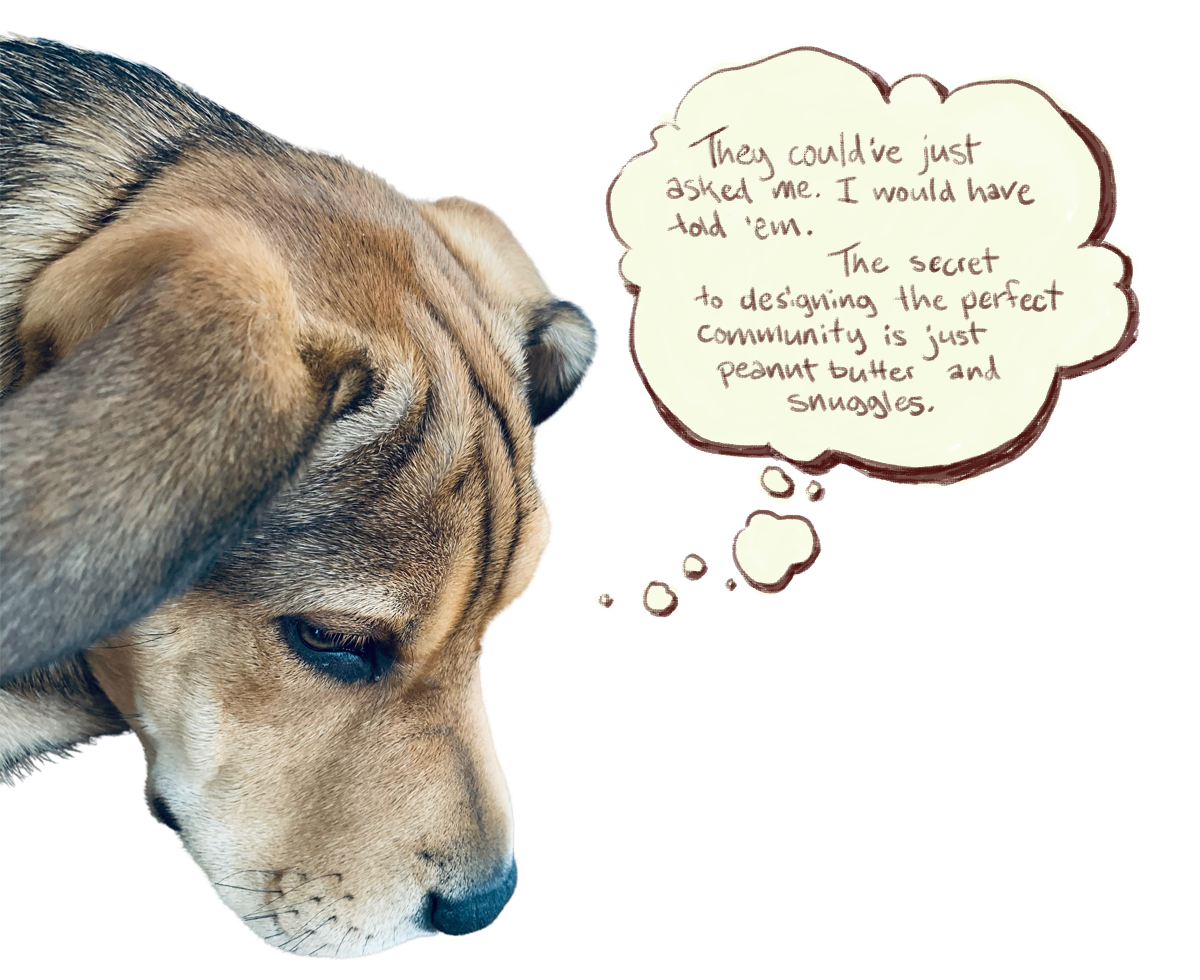
Wow, if you’ve actually read this far I owe you something special. Here’s my incredibly cute puppy being the very cutest. If you didn’t read this far but just assumed that there would be something good at the end, brilliant! Enjoy that wrinkly cuteness.
I’m so grateful that you would take the time to consider all of this. You are a beautiful, magnificent, eternal vector of divine presence. Thank you for taking some time to consider joining me in building my little design firm into a monumental force for good.
cheers,
Deacon